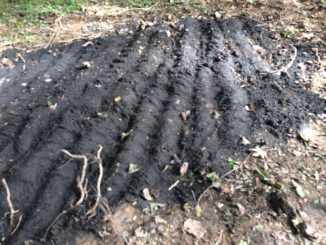
This is my first experiment with Ginseng. Honestly I have no idea if we will be able to grow here in Apex, but seeds aren’t terribly expensive, the soil is similar enough to the mountains, and the weather has been cool and wet as of late… plus I have a few nice shady spots in the trees out back so I decided it was worth a try.
Of all the reading I’ve done on Ginseng there are a few common rules:
- Put it on a North / North-east slope so it doesn’t get much sun
- Make sure it is under trees or shade cloth to further that effect
- Plant in the Fall so the cold helps to activate it
- It likes cover and mulch
These conditions seem pretty simple to fulfill, the only thing left was to take my north slope and change it from clay to decently loamy soil. So I started by pulling out the tractor and lowering the tines on the box blade to their lowest setting. Then I made a few passes down the hill to pull the big roots and get the clay broken up.
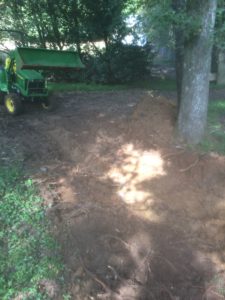
I used the loader to pull up about 12-18″ deep of clay in a 5′ strip and put it in a pile to be reconditioned. I then worked the bottom of the trench with a pitch fork to break it up even deeper and let the amended soil seep deeper as well.
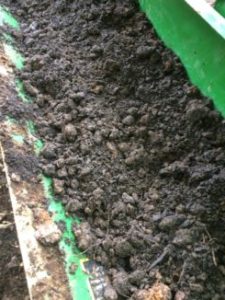
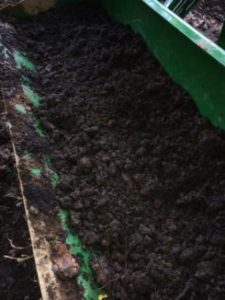
The reconditioning process would be very tricky to do with a wheel barrel. I used the load to pick up about half a bucket at a time. Then I used the bucket to add peat moss, cow compost, and top soil to the clay to make the mixture much more loamy.
With each addition I would mix in with a shovel and pitch fork the additive to the clay and continue breaking it up.
Just like cooking, the additives generally would stick to the clay and allow it to break up even more with every turn. After the three amendment processes the soil was very loose and a nice mixture of water retaining peat moss, nutrient rich compost, and sandy topsoil with the original clay. This left me with a full bucket at the end of the amendments.
It took several buckets to fill in the 10 foot by 5 foot trench I had dug.
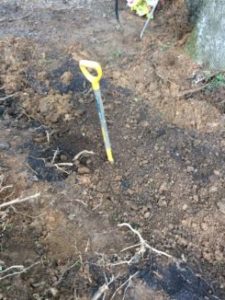
By the end of the process I had a beautiful … more or less “Bastard” dug trench, which despite the lack of direct sunshine should be a happy haven for plants. My pitchfork would sink up to the base of the tines with minimal effort, compared to the 2″ it would sink in the soil (clay) originally.
What I realized though was that since this was on a hill, and I’ve already experienced a non level trenched bed all running together, was that I needed some kind of leveled support. So I took 1×6’s and pushed them into the trench horizontally to provide tiers. This was an experiment, but it seemed like it would wash out to a level for each tier, and I thought it was worth a try.
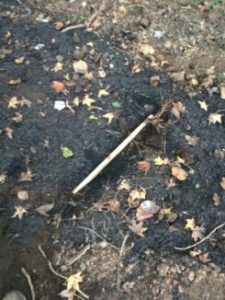
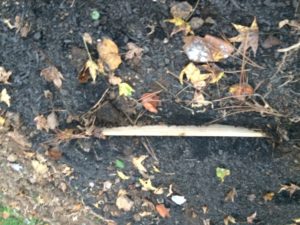
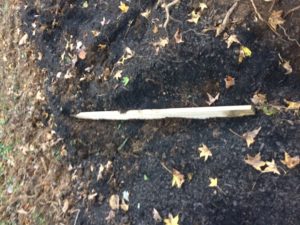
Then came Hurricane Matthew.
Well, if you want to test a theory, there is nothing like throwing the worst possible conditions at it to validate it. Long story short, it worked… kind of. The ground was so saturated I had a makeshift creek literally spring out of the ground in the backyard just a couple feet away from the trench. The trench at its bottom exhibited similar characteristics… and some of the very base washed away. The “tiers” with the boards actually held up pretty well… they did lose a bit of soil, but largely remained intact. So it appears my experiment was a success.
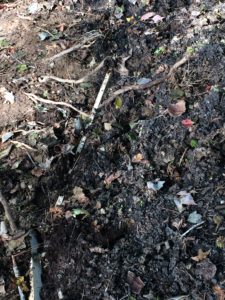
Once the ground had a chance to dry out a bit I followed up on the board idea by pushing in a number of 1×4’s along the side of the trench to help prevent tree root encroachment as well, and added about 16 bags of topsoil to the mix to fill in what I had lost. This might dilute my original mixture a good bit since ginseng is planted only a half an inch deep, but I didnt want it to be a puddle in the next hurricane either.
Next I raised rows through the bed horizontal to the hill and planted seeds 1/2 inch deep by 4-6 inches apart and lightly padded them in.
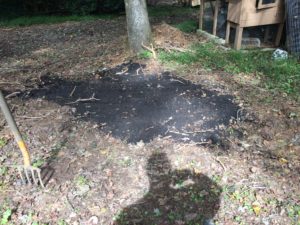
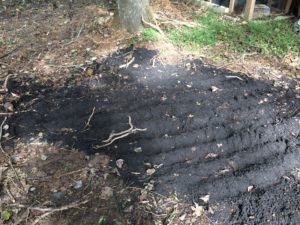
Last I covered the whole thing with a couple inches of mulch.
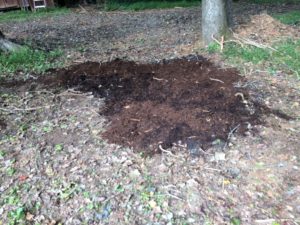
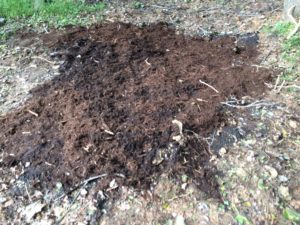
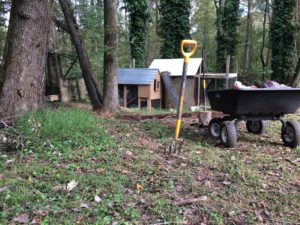
Now we wait and see… I’ll be trying my best to give them a good watering once a week, which the peat moss and mulch should keep nice and moist throughout the rest of the week and we will see if there is any activity next spring!
Sadly, this is an effort of patience. If all goes well I will end up with a number of little plants which produce seeds… first 1, then 2, then 3 at a time. If this works out I will be taking those seeds and further expanding the hill ginseng patch.
There isn’t alot here, its a small patch of 200 seeds, of which any number might fail… so its not going to be much money and will likely take 10 years to be ready to harvest. But this isn’t so much an effort to make money on the ginseng as it is to learn about the plant and see if we can get it to grow here.