Soil additionally can have inbalances of nutrients, undesirable pollutants, high concentrations of salt, and/or contain plant diseases in the soil which makes rotation, close monitoring and management a much more difficult task.
We want to reduce the overhead, not increase it (or even put up with what currently exists). Every advantage we can leverage to reduce the factors that will add to uncertainty need to be isolated, controlled and eliminated whenever possible.
As such we are experimenting with a number of options to see what provides an affordable alternative to soil might work. We have identified several possible types and are discovering pro’s and cons for each regularly. To properly evaluate them we need some kind of scale that will give us a valid comparison (so we dont get influenced by the hype and marketing). I’m going to use the following scale with the following critieria to get started:
- Moisture retention: How well does the media maintain moisture for the plants consumption. Better retention provides longer periods between watering, but could also kill roots if in a constant submerged situation.
- PH influencer: The media combining with chemicals / nutrients / water can degrade and alter the PH of the system.
- Planting efficiency: Long story short, how hard is it to plant in? Are there sharp corners that could damage roots? Is it heavy and unwieldy? Does it require alot of of maintainance?
- Reusability: How hard is it, or can we even reuse the same media year on year. Can we use it in the same place or does it require rotation?
- Effect on host systems: Various media can have small fibers which could clog filters, or small granules, or diminish like dirt and spread out.
- Cost
Lets talk about a few:
- Coco Coir:
- Description: One of the more popular in hydro/aquaponic systems are the coconut derived medias. They also seem to be some of the top growers.
- Moisture retention: The coconut derivatives appear to provide excellent moisture retention.
- PH impact: It appears this is negligible.
- Planting efficiency: This is likely one of the most “natural” feeling medias. It is very similar to soil.
- Reuse: I don’t think they will be quite as reusable as the other media types, but I could be wrong. This will be determined more clearly when I try to boil and sanitize the media later this year. It may also be difficult to remove leftover organics.
- Effect on host systems: Use in net pots with drip systems it will likely not be a significant problem. Especially for the benefits you derive.
- Cost: It doesn’t appear very expensive. It seemed quite costly at first, but once I realized the bricks expand into large quantities or material. This will likely be the basis for dutch bucket attempts next year.
- HDPE foam:
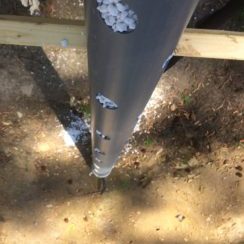
- Description: Used frequently in Tower systems, I have also seen “pool noodles” as a cheap alternative. This is a standard filling type for commercial square style towers.
- Moisture Retention: It provides an excellent means of water flow with some retention, and roots happily dig in.
- PH Impact: There is a negligible PH effect.
- Planting efficiency: Relatively simple but specific to towers or cup sizes. Tower foams are generally 2 piece or folded so you just spread and place your roots. Cup versions require cutting and folding to pinch the roots.
- Reuse: Reuse may be difficult due to it being one large piece and therefore hard to scrub all the nooks clean. If it was protected from the start it might be ok (in a greenhouse with controlled circumstances).
- Effect on host systems: Being plastic some people have issues with its potential effects on the water and leeching into the foods. I have read several articles saying this is minimal to non-existent and not a real concern… more just people that dont like plastic. Planting is relatively simply as you can cut or fold the material to insert roots. The effect on the total system might be a little less desirable if it retains organics.
- Cost: Pricing can be very expensive to minimal depending on your approach. Pool noodles out of season are cheap but are better for collars than a constant drip system. Foam (like gutter guard material) would end up costing 8-12 dollars per tower which can get expensive pretty quickly. But in the grand scheme, for something that will be used over many seasons it could be considered good deal.
- Perlite:
- Description: An expanded stone product which is lite like popcorn. Even though it is stone, it actually floats in water.
- Moisture Retention: It has many miniscule ridges and provides excellent water retention, so is very suitable for methods that should clear out.
- PH Impact: It appears to have zero PH impact.
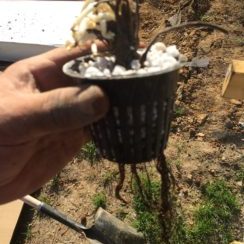
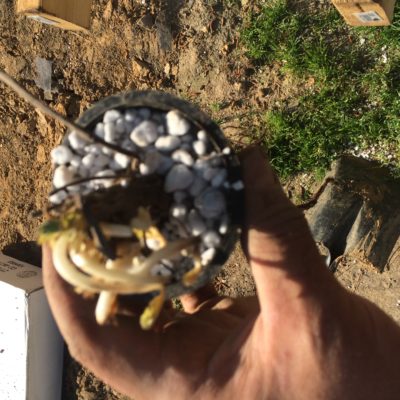
- Planting efficiency: I used the large grain horticultural variety. It was very easy to work with, with the exception that it is so light. I am going to build a system similar to a trains water tower to make it simpler to load towers and buckets without spilling quite so much for next year.
- Reuse: Gardeners frequently mix it into their beds to increase moisture retention. It is often a substitute for Peat Moss but never needs to be replaced (since its stone… it doesnt degrade).1 bag did all the net cups for our 200 tower cups and had some left over.
- Effect on host systems: I went with large granule and still had some issues where it would clog the return lines. I found a simple mesh filter added to each tower fixed the problem, but its still extra effort.
- Cost: It comes in large or small size bags and buying in bulk drops the price to only around $18 for 3-4 cubic feet.
- Hydroton:
- Description: A bit heavier than Perlite and much larger, hard clay balls the size of smallish marbles. I had read that it was a good cover for Perlite to keep it from blowing away, and this seems to be true. But its the same basic idea as Perlite.
- Moisture Retention: Excellent, as each “marble” has lots of little ridges and grooves to trap and hold water.
- PH Impact: It should provide no or at least negligible PH impact.
- Planting efficiency: Planting is a little less natural since the chunks (while round, so no edges) are much larger.
- Reuse: This should have the same benefits as Perlite. Its Clay, but I am going to try putting it into a boiling water bath to sanitize. I believe I’ll need to add a microscope to the project to determine the length of time before living things are cleared out.
- Effect on host systems: Hydroton would be a wonderful medium if it wasn’t quite so expensive. But you do have to factor in that it is infintely reusable (or at least appears to be).
- Cost: It also was substantially more expensive than Perlite but seems to be the golden standard if you are going to buy into a full on name brand style hydroponics setup.
- Stone:
- Description: There are a number of kinds of suitable stones for hydro / aquaponics. There are brick chips, granite, river pebbles, and all are relatively reasonable and easily available at any home improvement store.
- Moisture Retention: Varies, depends on the stone you use, but anything near natural is likely going to have alot of ridges and valleys that will retain a reasonable amount of moisture.
- PH Impact: Stone is the most likely to significantly alter your PH unintentionally. You can perform tests using baking soda or vinegar to help determine if its acidic or a heavy base and might impact your environment heavily. This is of extra high concern when it comes to Aquaponic systems that include living critters.
- Planting efficiency: Stone is the most likely to have sharp edges, degrade and require substantial startup maintainance to get it cleaned up and usable. The likelyhood of damaging plant roots is a strong possibility. Its also the heaviest of the mediums and just a few bags can really take its toll when constantly lifting and moving.
- Reuse: Stone should be mostly cleansable and reusable leveraging the same boiling technique.
- Effect on host systems: Stone can influence PH and can put a high level of stone dust in the water that could impact other parts of the system from pumps to filters.
- Cost: Stone is one of the cheapest alternatives. Many times you can buy in bulk from landscaping quarries, or just on sale for several bags at the home improvement center.
Reuse techniques. I am focusing my research primarily on reusable media. But I need to establish a means of sanitizing. The first I am going to try is a boiling water bath. 55 gallon steel drum over a fire until boiling. We need to establish if this clears all the potential disease for the following season. Some of the media will likely not take well to this approach including the HDPE foams. They may either melt, or the roots and left over organics will not scrub out like we can with the loose perlite in the bath.
These various media types are in use in several forms throughout our experiments. I would like to see Potatoes, Tomatoes, and filled towers using the various methods. I am fairly confident the Perlite has performed adequately for what I’m trying to achieve in our net cups and that we will be sticking with it for those methods. The others are worth evaluating and we should have more information as the years (this year / next year) really allow us to get solid results.